

ARTICLES
May 13, 2026
BERNAYS vs. ADLER: The Soul of Marketing
Proven legal marketing strategies from Honorable Marketing. Learn how solo and small law firms use AI, SEO, and smart systems to attract more clients and domina
September 26, 2024
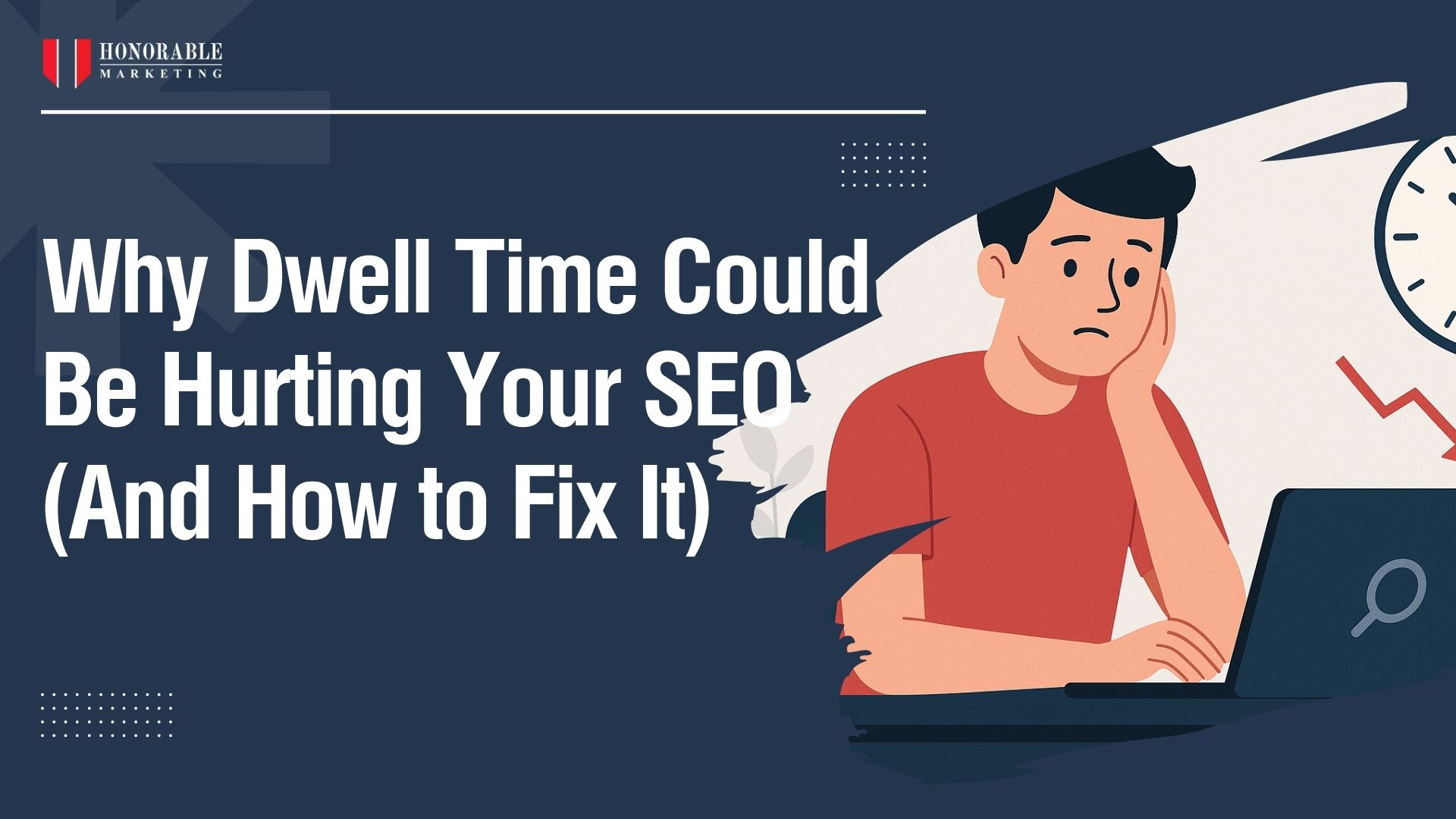
Are you doing everything right with your SEO, but still struggling to rank for a key keyword? The issue might be your dwell time—the length of time a visitor spends on your website before returning to the search results. If people leave your site quickly, search engines may interpret that as a sign that your content isn’t relevant or engaging enough.
Here’s how to identify and fix poor dwell time to improve your ranking.
Dwell time refers to how long a visitor stays on your website before returning to the search results. If someone clicks on your site and then quickly clicks back, that short dwell time can indicate to search engines like Google that your content didn’t meet their expectations.
Low dwell time could be a sign of several things:
Search engines pay attention to dwell time because it’s an indicator of how satisfied users are with your content. High dwell time often correlates with content that answers the user's query, while low dwell time may signal the opposite.
While you can’t directly track dwell time in Google Analytics, you can monitor bounce rate and session duration as indirect metrics. A high bounce rate or short session duration often points to issues with dwell time. You should also look at pages per session to see how effectively users are navigating your site.
Additionally, at Honorable Marketing, we leverage Microsoft Clarity to get a more in-depth understanding of user behavior. Clarity allows us to track rage clicks, dead clicks, scroll depth, and even watch real-time session recordings to see exactly how users interact with your site. This tool is invaluable in identifying areas where users might be getting frustrated or confused, helping us fine-tune your website for maximum engagement and longer dwell times.

The most obvious reason visitors might leave your website quickly is that the content isn’t what they expected. To fix this:
A slow-loading page can cause visitors to hit the back button almost immediately. Page speed is a huge factor for both SEO and user experience. Consider using tools like Google PageSpeed Insights to identify areas where you can speed up your website, such as compressing images, minifying code, or using a content delivery network (CDN).
With Clarity, we can also monitor how page speed impacts user frustration. By reviewing session recordings, we can see where users are dropping off and make targeted improvements to enhance performance.
Poor website design or confusing navigation can lead users to exit your site quickly. To improve UX:
Microsoft Clarity helps us track where users are clicking on your site and identify dead zones or areas that aren’t performing as expected. This allows us to make data-driven changes that enhance the overall user experience.
Videos, infographics, and interactive tools can increase dwell time by offering more engaging ways to consume your content. For example, a family law firm could include a divorce process explainer video or an interactive child custody calculator to keep visitors on the site longer.
Internal links guide users to other relevant content on your website, increasing the likelihood they will stay on your site longer. Make sure your internal links are strategically placed and lead to valuable content that answers your visitors' questions.
Beyond the content and UX improvements, technical SEO plays a significant role in improving dwell time. Fixing issues like broken links, redirects, and site structure can keep users from getting frustrated and leaving your site.
Dwell time issues are often complex and multifaceted, involving everything from technical SEO to on-page optimization and website design. If you’ve tried everything and still aren’t seeing results, it might be time to consult professionals. At Honorable Marketing, we specialize in helping businesses improve their SEO rankings through comprehensive website audits, on-page optimization, and user-focused design updates. Using tools like Microsoft Clarity, we ensure you’re always equipped with the data you need to succeed.
Contact us today to learn how we can help optimize your website and improve your SEO rankings.
This article was produced by the editorial team at Honorable Marketing, a veteran-owned digital marketing agency working exclusively with personal injury attorneys and small law firms across the United States. Our strategies comply with ABA Model Rules of Professional Conduct and applicable state bar advertising guidelines — particularly Rules 7.1 through 7.5 governing attorney advertising, solicitation, and communication about services.
Attorneys should review their specific state bar Rules of Professional Conduct before implementing any marketing campaign, especially regarding testimonials, case results, fee representations, and comparative advertising. For a personalized strategy session, contact Honorable Marketing here.
At Honorable Marketing, we implement these strategies as integrated systems — not isolated tactics. Every campaign we build for a law firm begins with a thorough audit of the existing digital presence, a competitor intelligence analysis, and a clear 90-day roadmap tied to measurable business outcomes.
We work exclusively with solo and small law firms because we believe the independent attorney deserves the same quality of marketing infrastructure as the largest firms in their market. Our veteran-owned team brings military-grade discipline, strategic precision, and a commitment to honor-first results that generic agencies cannot match. Schedule your free strategy session here.
Impressions and clicks are not business metrics. The only marketing metrics that matter for a law firm are cost-per-lead, cost-per-consultation, cost-per-signed-case, and case value by acquisition source. Set up call tracking (CallRail or WhatConverts), form conversion events in Google Analytics 4, and a CRM that records lead source at intake before you spend a dollar on any campaign.
Review these numbers monthly. Double down on channels delivering the lowest cost-per-case. Eliminate channels that consume budget without producing consultations. This discipline — not creative ad copy or viral content — is what builds a predictable client acquisition system that grows year over year.
The most common reason law firm marketing initiatives fail is not lack of budget or bad strategy — it is inconsistent implementation. Attorneys launch campaigns with enthusiasm, get busy with cases, and abandon the process before it has time to compound. The solution is to build systems, not rely on willpower.
Start with the single highest-leverage action identified in this guide. Complete it fully before moving to the next. Document your process so it can be delegated or outsourced as your firm grows. Measure results monthly against specific KPIs, not vague feelings about whether marketing is "working." That operational discipline is what separates growing firms from stagnating ones.
Solo and small firm attorneys operate in one of the most competitive marketing environments in professional services. Big Law spends millions annually on brand awareness campaigns that small firms cannot match dollar-for-dollar. The advantage for agile solo practitioners lies in precision — targeting the specific clients, specific search queries, and specific trust signals that convert at the highest rate in your local market. This strategy is built for that precision.
Every tactic covered in this guide has been deployed with real law firm clients and refined based on measurable results: lead volume, consultation bookings, cost-per-case, and long-term organic rankings. The goal is not to look busy. The goal is to generate clients.
Solo and small firm attorneys compete by deploying precision tactics that large firms cannot execute at scale. Local SEO, niche authority content, AI-powered intake automation, and systematic review acquisition all favor the agile solo practitioner. Big Law's budget buys broad awareness. Your strategy buys specific clients — and specific clients convert.
Timeline varies by channel. Google Local Services Ads and paid PPC can generate leads within 72 hours of launch. Local SEO and Google Maps optimization typically show measurable improvement in 60–90 days. Organic content authority and backlink building require 6–12 months of consistent execution. The firms with the strongest long-term results combine all three: immediate paid wins, medium-term local SEO, and long-term content authority.
For most solo attorneys, fully optimizing your Google Business Profile and building a systematic review acquisition process delivers the highest ROI at the lowest cost. It is free to use, directly affects local pack rankings, and requires ongoing maintenance rather than ongoing spend. Once your local presence is strong, layer in paid advertising and content marketing to amplify results.
Track cost-per-lead, cost-per-consultation, and cost-per-signed-case by channel — not impressions, clicks, or pageviews alone. Use call tracking software (CallRail, WhatConverts), form conversion events in Google Analytics 4, and a CRM that records lead source at intake. Review these numbers monthly. Cut channels that consume budget without producing consultations. Double down on channels with the lowest cost-per-case.