

ARTICLES
May 13, 2026
BERNAYS vs. ADLER: The Soul of Marketing
Proven legal marketing strategies from Honorable Marketing. Learn how solo and small law firms use AI, SEO, and smart systems to attract more clients and domina
July 30, 2025
The legal industry is still stuck in brochure mode.
Let’s be real—most law firm websites aren’t built to convert. They’re built to look “professional.” That means stock photos of gavels, endless dropdown menus, and mission statements no one reads.
If your site looks like it was designed by a bar association intern from 2014, it’s not just outdated, it’s bleeding opportunity.
You didn’t get into law to be a digital marketer. But if your website isn’t acting like a lead-generation machine, it’s just a digital business card... floating in a hurricane.
Big Law firms can afford that. They’ve got entire marketing departments who waste six months on brand guidelines before touching a landing page. They can afford to be inefficient. You can’t.
Solo and small firms live and die by the quality of their next ten leads. Your website can’t just look nice, it has to hunt.
It should attract, engage, and book. On autopilot. With speed, clarity, and direction.
We’re not talking about pretty design, we’re talking about functional strategy. That’s where AI gives you the upper hand. When deployed right, your website becomes a trained digital operator:
This isn’t optional anymore. It’s operational.
👉 Want to see how small firms are already using AI to do this right?
Check out what makes an AI-powered site work →
You can feel when your site isn’t working—you just don’t always have the language for it.
Here’s what we see all the time in broken funnels:
Your website should be your sharpest tool.
But right now, most firm sites are dull knives in a gunfight.
The legal system is cold, chaotic, and cluttered. Your prospects are anxious, skeptical, and short on time.
If your site doesn’t connect fast—if it doesn’t show clarity and leadership in the first 5 seconds—they’re gone.
And if it does connect, but then just drops them into a dead-end form with no response… you just wasted attention.
That’s not just poor UX. That’s bad business.
But it’s fixable.
AI doesn’t make your website fancier. It makes it functional. You don’t need gimmicks. You need a digital soldier that does the job right—24/7.
🎯 Ready to fix the cracks in your current site?
Grab your free site audit checklist here →
Most law firm websites are built like resumes. A little About section. Practice areas. A contact form. Maybe a blog with two posts from 2019.
They think if they just “have a site,” that’s enough. But that’s like setting up a tent in a war zone and calling it a base.
It’s not enough to exist. Your site has to fight.
It should take cold traffic and move it somewhere on purpose. A click. A download. A call. Anything that pulls people into your orbit.
That doesn’t happen by accident. It happens by design.
What most firms don’t realize is they’ve been sold a lie—by web designers, SEO agencies, or their own assumptions:
“If it looks clean and ranks on Google, it’ll generate leads.”
Wrong.
Design is just paint. SEO without conversion is noise. And “traffic” that doesn’t turn into calls is worthless.
What you need is a system.
A digital operator that knows exactly what to do when someone lands on your page.
It needs to adapt, respond, and take initiative.
That’s where AI flips the table. You’re not guessing what works anymore. You’re testing, learning, and optimizing in real time—just like the big players, but without the red tape.
AI-powered sites don’t guess what your lead wants. They ask, adapt, and deliver. That’s not just good UX. That’s elite positioning.
🚀 Want a blueprint for this kind of strategy?
See how AI Funnels outperform old-school sites →
Let’s talk tactics.
You’ve got a user. They land on your site at 10:42 PM on a Tuesday. They’re not ready to call. They’re just scared and looking for answers.
Here’s what an AI-driven site does next:
That’s not theoretical. That’s what we build.
This is how solo firms are winning without spending $10K/month on marketing agencies.
AI doesn’t just make your site smarter—it makes it simpler.
It’s like hiring a team of intake staff, marketing coordinators, and project managers… without the payroll.
✅ Want to see this flow in action?
Explore the AI-powered funnel solo firms are using →
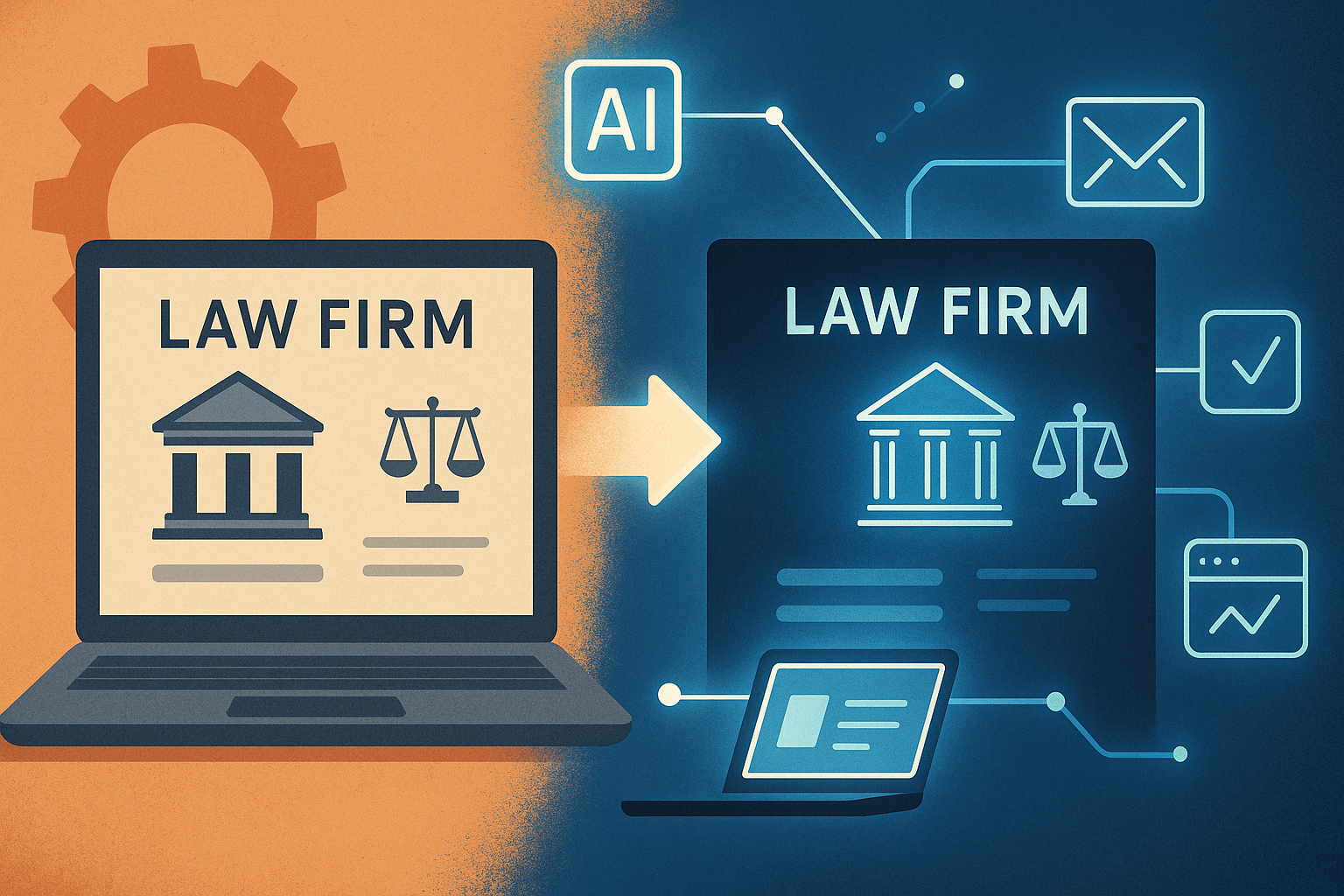
The legal system moves slow. But tech moves fast. And for once, small firms have the edge—because you can pivot without approval chains and committee meetings.
These tools aren’t gimmicks. They’re force multipliers:
You don’t need all of them. But you do need a system.
One that works while you’re in court, with your kids, or resting for once.
Once in place, you won’t go back.
Time to get tactical. If your site’s not producing leads daily, it’s time for a gut check.
Here’s your 5-step fix:
Install heatmaps. Watch recordings. Learn where people drop off and fix the leaks.
Once your site becomes a system, it stops being a liability and starts becoming a weapon.
Not because it’s flashy.
Not because it won awards.
But because it does the job.
Every. Single. Day.
That’s freedom. That’s leverage. That’s what we build.
✅ Want help turning your site into a client‑generating system?
Book Your Funnel Strategy Call →
Even AI pipelines fail when built on weak foundations:
Failing to fix these leaks means your system never performs. But when they're addressed, your site becomes a silent partner in growth.
✅ Want a funnel audit from someone who builds systems, not just sites?
Request a Funnel Audit →
This article was produced by the editorial team at Honorable Marketing, a veteran-owned digital marketing agency working exclusively with personal injury attorneys and small law firms across the United States. Our strategies comply with ABA Model Rules of Professional Conduct and applicable state bar advertising guidelines — particularly Rules 7.1 through 7.5 governing attorney advertising, solicitation, and communication about services.
Attorneys should review their specific state bar Rules of Professional Conduct before implementing any marketing campaign, especially regarding testimonials, case results, fee representations, and comparative advertising. For a personalized strategy session, contact Honorable Marketing here.
At Honorable Marketing, we implement these strategies as integrated systems — not isolated tactics. Every campaign we build for a law firm begins with a thorough audit of the existing digital presence, a competitor intelligence analysis, and a clear 90-day roadmap tied to measurable business outcomes.
We work exclusively with solo and small law firms because we believe the independent attorney deserves the same quality of marketing infrastructure as the largest firms in their market. Our veteran-owned team brings military-grade discipline, strategic precision, and a commitment to honor-first results that generic agencies cannot match. Schedule your free strategy session here.
Impressions and clicks are not business metrics. The only marketing metrics that matter for a law firm are cost-per-lead, cost-per-consultation, cost-per-signed-case, and case value by acquisition source. Set up call tracking (CallRail or WhatConverts), form conversion events in Google Analytics 4, and a CRM that records lead source at intake before you spend a dollar on any campaign.
Review these numbers monthly. Double down on channels delivering the lowest cost-per-case. Eliminate channels that consume budget without producing consultations. This discipline — not creative ad copy or viral content — is what builds a predictable client acquisition system that grows year over year.
The most common reason law firm marketing initiatives fail is not lack of budget or bad strategy — it is inconsistent implementation. Attorneys launch campaigns with enthusiasm, get busy with cases, and abandon the process before it has time to compound. The solution is to build systems, not rely on willpower.
Start with the single highest-leverage action identified in this guide. Complete it fully before moving to the next. Document your process so it can be delegated or outsourced as your firm grows. Measure results monthly against specific KPIs, not vague feelings about whether marketing is "working." That operational discipline is what separates growing firms from stagnating ones.
Solo and small firm attorneys operate in one of the most competitive marketing environments in professional services. Big Law spends millions annually on brand awareness campaigns that small firms cannot match dollar-for-dollar. The advantage for agile solo practitioners lies in precision — targeting the specific clients, specific search queries, and specific trust signals that convert at the highest rate in your local market. This strategy is built for that precision.
Every tactic covered in this guide has been deployed with real law firm clients and refined based on measurable results: lead volume, consultation bookings, cost-per-case, and long-term organic rankings. The goal is not to look busy. The goal is to generate clients.
Solo and small firm attorneys compete by deploying precision tactics that large firms cannot execute at scale. Local SEO, niche authority content, AI-powered intake automation, and systematic review acquisition all favor the agile solo practitioner. Big Law's budget buys broad awareness. Your strategy buys specific clients — and specific clients convert.
Timeline varies by channel. Google Local Services Ads and paid PPC can generate leads within 72 hours of launch. Local SEO and Google Maps optimization typically show measurable improvement in 60–90 days. Organic content authority and backlink building require 6–12 months of consistent execution. The firms with the strongest long-term results combine all three: immediate paid wins, medium-term local SEO, and long-term content authority.
For most solo attorneys, fully optimizing your Google Business Profile and building a systematic review acquisition process delivers the highest ROI at the lowest cost. It is free to use, directly affects local pack rankings, and requires ongoing maintenance rather than ongoing spend. Once your local presence is strong, layer in paid advertising and content marketing to amplify results.
Track cost-per-lead, cost-per-consultation, and cost-per-signed-case by channel — not impressions, clicks, or pageviews alone. Use call tracking software (CallRail, WhatConverts), form conversion events in Google Analytics 4, and a CRM that records lead source at intake. Review these numbers monthly. Cut channels that consume budget without producing consultations. Double down on channels with the lowest cost-per-case.