

ARTICLES
May 13, 2026
BERNAYS vs. ADLER: The Soul of Marketing
Proven legal marketing strategies from Honorable Marketing. Learn how solo and small law firms use AI, SEO, and smart systems to attract more clients and domina
July 30, 2025
Let’s call it what it is: most law firm marketing funnels aren’t funnels at all—they’re hope machines. And hope isn’t a system. You’ve got small firms duct-taping together old‑school tactics. A Google ad here. A referral there. Maybe a “free consult” form buried three clicks deep on their website. And when leads do come in? No follow‑up, no segmentation, no system. Just a prayer that the right person clicks at the right time and doesn’t ghost after the intake call. The real problem? These Frankenstein funnels are built like the court system—slow, reactive, and painfully rigid. They're not designed to scale. They're barely designed to survive. Meanwhile, Big Law throws cash at agencies who churn out bloated content and vague metrics like “brand lift.” They can afford to be inefficient. You can’t. You’re not building a brand. You’re building a machine. And that machine needs to do one thing well—turn attention into appointments. Not next month. Not “after the next campaign.” Daily. Predictably. Automatically. That’s where AI funnels change the game. Not because it’s trendy—but because it actually works. When built right, it becomes your most loyal employee—24/7, never sleeps, never forgets a follow-up, and never drops the ball. And here's the kicker: you don’t need to be a tech geek or hire a fancy firm to do it. You just need the right mission, the right tools, and the guts to build outside the system. Let’s break it down.

Forget the buzzwords. AI doesn’t mean robots in suits or a chatbot trying to sound like a lawyer. An AI funnel is just a smart, automated system that captures interest, nurtures trust, and books calls—without you having to chase leads like a dog in traffic. At its core, it’s this:
Think of it like your own marketing infantry—trained, responsive, and mission-driven. You set the tone. You give it the orders. Then it executes with precision. Here’s the best part: the tools are already in your hand.
And here’s why it matters now more than ever: Attention spans are collapsing. Competition is rising. And trust is at an all‑time low. The lawyer who responds first—with clarity, value, and humanity—wins the case before it ever hits the office. That’s what an AI funnel does. It doesn’t replace you. It frees you to lead.
✅ Want to see how real firms are deploying this system?
See the AI Funnel Breakdown →
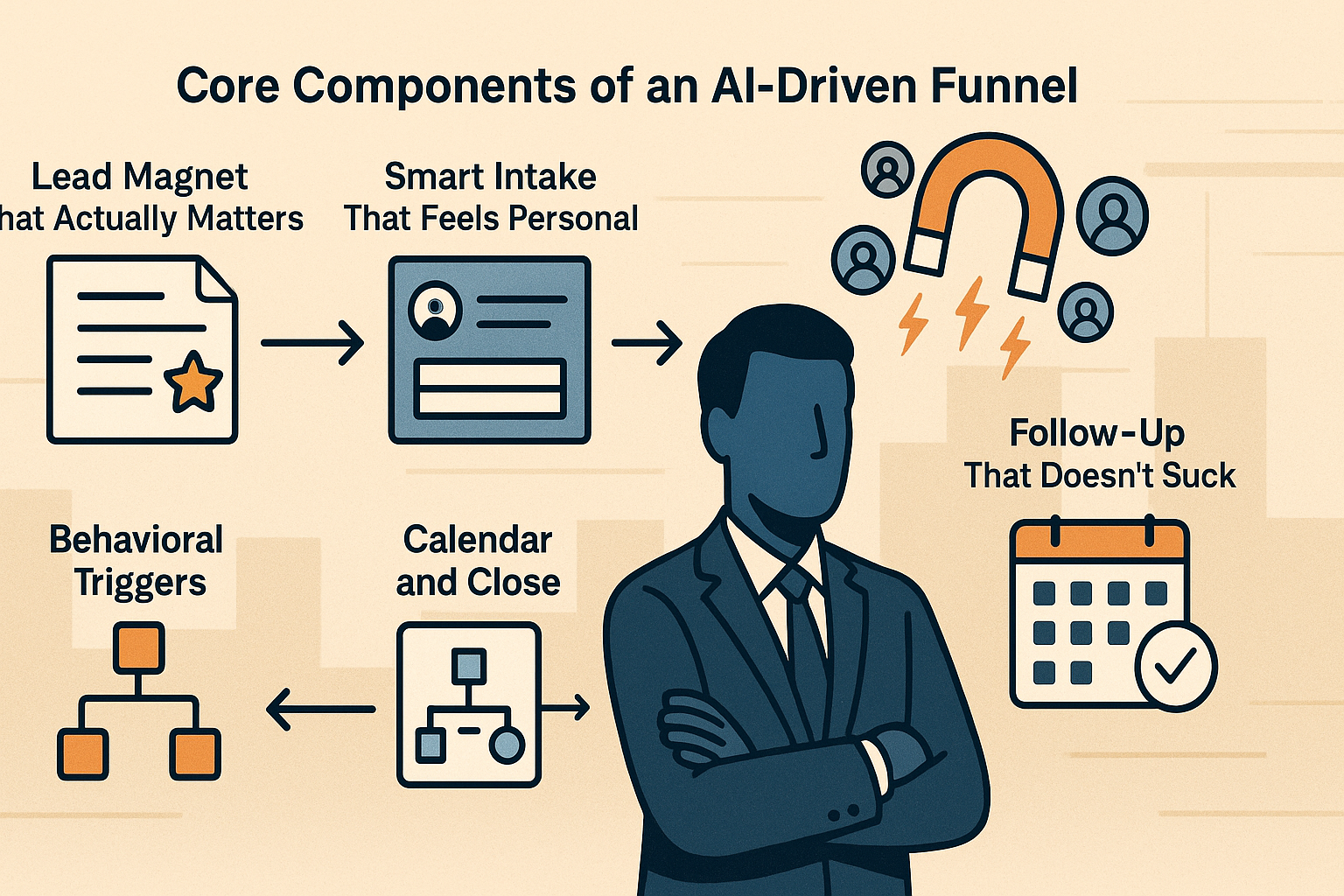
This is where theory turns into ammunition. These five pieces determine whether your funnel just collects emails—or closes clients.
✅ Want to see this flow in action?
View the funnel map solo firms are using →

This is battle‑ready, not hypothetical. Here's the two‑day mission plan:
Day 1: Mission Planning
Day 2: Firepower & Automation
Walk the funnel as if you’re the lead. Smash anything that doesn’t scale. Launch it. It works.
✅ Want help deploying yours fast and loud without losing voice?
Let’s Build Your Funnel →
Even smart funnels fail when built on sloppy foundations. These are the five most common mistakes I see:
✅ Need someone battle-tested to audit your funnel setup? Request our Funnel Audit →
Picture this: it’s 3 PM. You’re in a deposition. Meanwhile, someone lands on your site—the funnel kicks in: value PDF, follow-up video, SMS, call scheduled, prep materials sent. You haven’t lifted a finger. Your “machine” did it all. That is leverage. That is freedom. That is how smart firms win local markets. That’s not dreamland—it’s reality with AI funnels built and deployed right.
✅ Want that system on the ground in your firm?
Schedule a Funnel Strategy Call →
This article was produced by the editorial team at Honorable Marketing, a veteran-owned digital marketing agency working exclusively with personal injury attorneys and small law firms across the United States. Our strategies comply with ABA Model Rules of Professional Conduct and applicable state bar advertising guidelines — particularly Rules 7.1 through 7.5 governing attorney advertising, solicitation, and communication about services.
Attorneys should review their specific state bar Rules of Professional Conduct before implementing any marketing campaign, especially regarding testimonials, case results, fee representations, and comparative advertising. For a personalized strategy session, contact Honorable Marketing here.
At Honorable Marketing, we implement these strategies as integrated systems — not isolated tactics. Every campaign we build for a law firm begins with a thorough audit of the existing digital presence, a competitor intelligence analysis, and a clear 90-day roadmap tied to measurable business outcomes.
We work exclusively with solo and small law firms because we believe the independent attorney deserves the same quality of marketing infrastructure as the largest firms in their market. Our veteran-owned team brings military-grade discipline, strategic precision, and a commitment to honor-first results that generic agencies cannot match. Schedule your free strategy session here.
Impressions and clicks are not business metrics. The only marketing metrics that matter for a law firm are cost-per-lead, cost-per-consultation, cost-per-signed-case, and case value by acquisition source. Set up call tracking (CallRail or WhatConverts), form conversion events in Google Analytics 4, and a CRM that records lead source at intake before you spend a dollar on any campaign.
Review these numbers monthly. Double down on channels delivering the lowest cost-per-case. Eliminate channels that consume budget without producing consultations. This discipline — not creative ad copy or viral content — is what builds a predictable client acquisition system that grows year over year.
The most common reason law firm marketing initiatives fail is not lack of budget or bad strategy — it is inconsistent implementation. Attorneys launch campaigns with enthusiasm, get busy with cases, and abandon the process before it has time to compound. The solution is to build systems, not rely on willpower.
Start with the single highest-leverage action identified in this guide. Complete it fully before moving to the next. Document your process so it can be delegated or outsourced as your firm grows. Measure results monthly against specific KPIs, not vague feelings about whether marketing is "working." That operational discipline is what separates growing firms from stagnating ones.
Solo and small firm attorneys operate in one of the most competitive marketing environments in professional services. Big Law spends millions annually on brand awareness campaigns that small firms cannot match dollar-for-dollar. The advantage for agile solo practitioners lies in precision — targeting the specific clients, specific search queries, and specific trust signals that convert at the highest rate in your local market. This strategy is built for that precision.
Every tactic covered in this guide has been deployed with real law firm clients and refined based on measurable results: lead volume, consultation bookings, cost-per-case, and long-term organic rankings. The goal is not to look busy. The goal is to generate clients.
Solo and small firm attorneys compete by deploying precision tactics that large firms cannot execute at scale. Local SEO, niche authority content, AI-powered intake automation, and systematic review acquisition all favor the agile solo practitioner. Big Law's budget buys broad awareness. Your strategy buys specific clients — and specific clients convert.
Timeline varies by channel. Google Local Services Ads and paid PPC can generate leads within 72 hours of launch. Local SEO and Google Maps optimization typically show measurable improvement in 60–90 days. Organic content authority and backlink building require 6–12 months of consistent execution. The firms with the strongest long-term results combine all three: immediate paid wins, medium-term local SEO, and long-term content authority.
For most solo attorneys, fully optimizing your Google Business Profile and building a systematic review acquisition process delivers the highest ROI at the lowest cost. It is free to use, directly affects local pack rankings, and requires ongoing maintenance rather than ongoing spend. Once your local presence is strong, layer in paid advertising and content marketing to amplify results.
Track cost-per-lead, cost-per-consultation, and cost-per-signed-case by channel — not impressions, clicks, or pageviews alone. Use call tracking software (CallRail, WhatConverts), form conversion events in Google Analytics 4, and a CRM that records lead source at intake. Review these numbers monthly. Cut channels that consume budget without producing consultations. Double down on channels with the lowest cost-per-case.